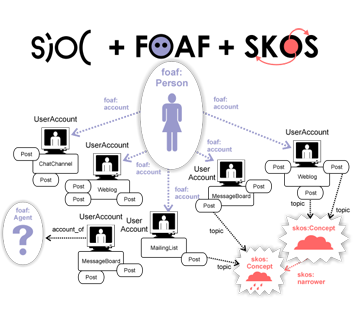
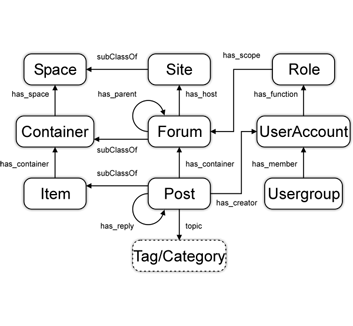
SIOC Logo What is SIOC? The SIOC initiative (Semantically-Interlinked Online Communities) aims to enable the integration of online community information. SIOC provides a Semantic Web ontology for representing rich data from the Social Web in RDF. It has recently achieved significant adoption through its usage in a variety of commercial and open-source software applications, and is commonly used in conjunction with the FOAF vocabulary for expressing personal profile and social networking information. By becoming a standard way for expressing user-generated content from such sites, SIOC enables new kinds of usage scenarios for online community site data, and allows innovative semantic applications to be built on top of the existing Social Web. The SIOC ontology was recently published as a W3C Member Submission, which was submitted by 16 organisations.

SIOC One Page Guides in PDF Format

We've created a series of three one-page summaries for those new to SIOC:


1: Executive Summary

2: User's Guide

3: Developer's Guide

Tales from the SIOC-o-sphere #7

20080403a.png It's been three months since my last round-up of all things SIOC-ed, so here is entry number seven in the series:

Previous SIOC-o-sphere articles:

#6 http://sioc-project.org/node/310
#5 http://sioc-project.org/node/294
#4 http://sioc-project.org/node/272
#3 http://sioc-project.org/node/271
#2 http://sioc-project.org/node/138
#1 http://sioc-project.org/node/79

SIOC Export API for Perl

Version 1.0 of an API for Perl has been released on CPAN!

The CPAN page for the SIOC API is at:

http://search.cpan.org/~geewiz/SIOC-v1.0.0/

A description of the project itself is available at:

http://sioc.socialware.at

Thanks to Jochen Lillich, Thomas N. Burg, and also to Internet Privatstiftung Austria (IPA) for funding this work.

Semantic Radar for Firefox

Semantic Radar is a semantic metadata detector for Mozilla Firefox.

SIOC tutorial accepted for WWW2008

I'm happy to announce that our tutorial proposal on SIOC entitled "Interlinking Online Communities and Enriching Social Software with the Semantic Web" (Uldis Bojars and John Breslin of DERI, NUI Galway, Alexandre Passant of EDF R&D / LaLICC, Université Paris 4) has been accepted for WWW2008, the 14th International World Wide Web Conference to be held in Beijing, China in April. The abstract is as follows:

Tales from the SIOC-o-sphere, part 6

Here are the latest happenings from the world of SIOC during the past few months, with thanks to all involved in supporting the initiative! (Note to new readers that SIOC is an open data format for community description.)

State of the SIOC-o-sphere (#5)

It's that random time of the year again where I summarise what's been going on in the world of SIOC...

SIOC is a W3C Submission

I am happy to announce that SIOC is now a W3C Member Submission, as mentioned today on the W3C SW blog.

The SIOC Ontology Submission is composed of:

  1. SIOC Core Ontology Specification
  2. SIOC Ontology: Applications and Implementation Status
  3. SIOC Ontology: Related Ontologies and RDF Vocabularies
  4. Snapshots of Namespace Documents

Thanks to Uldis for all his work, and to all our authors, contributors and supporters! More information about SIOC is available from sioc-project.org. Our SIOC work in DERI, NUI Galway is funded by Science Foundation Ireland.

State of the SIOC-o-sphere (#4)

Since my last SIOC update in November, here are some of the latest happenings from the SIOC-o-sphere:

A SIOC Explorer

Eyal and Benjamin have produced an explorer for SIOC forums. It's written using Ruby on Rails and their ActiveRDF / SWORD Semantic Web application framework for Rails. You can get it from the SIOC explorer page, which says:

SIOC is a Semantic Web format for online social communities such as forums, blogs, or mailing lists. SIOC feeds are already offered by many blogs (similar but much richer than RSS feeds). The SIOC explorer is a web application similar to a feed-reader: it allows people to subscribe to SIOC feeds and read their content. Because SIOC data is very rich, people can filter the content based on e.g. authors, topics, creation date, or any other properties.

Syndicate content